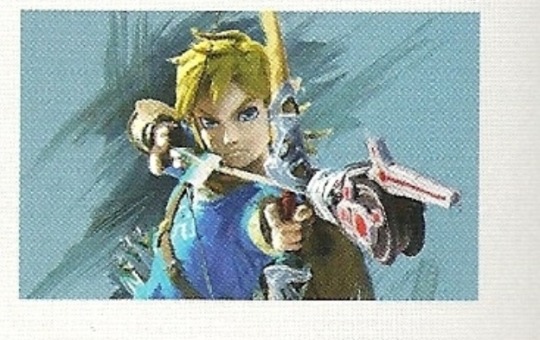
A tiny tidbit of news on The Legend of Zelda: Breath of the Wild. The recently released Hyrule Graphics art book in Japan reveals that the game’s art director is Satoru Takizawa. (Thanks, Nintendo Everything)
Takizawa art directed Twilight Princess, provided character designs for Ocarina of Time, and has also been involved with a number of other Nintendo projects over the years. Joining him as one of the art leads on Breath of the Wild is Takumi Wada, who last worked on The Legend of Zelda: Skyward Sword and was the natural choice for the newer game.
In an interview published in the art book, Wada reveals that he actually drew three versions of one of the early promotional images for Breath of the Wild, to experiment with different art styles. You can view these three variants above.
A fun little tidbit of info from the past—The Legend of Zelda: Ocarina of Time took 40-50 internal Nintendo employees to develop, and more than double that figure when you account for external contractors.
“Forty of fifty. It’s the biggest development group I’ve ever had. We also have a programming company working closely with us. If I include those people, maybe 120 people are working on Zelda altogether.” - Shigeru Miyamoto, Nintendo Power vol. 111, 1998
Leap 18 years into the future, and The Legend of Zelda: Breath of the Wild development team is over twice as large as Ocarina’s. The core team consists of over 100 staff, while the full list of people working on the game amounts to over 300. (Thanks, @NStyles)
At Nintendo’s 76th Annual General Meeting of Shareholders, The Legend of Zelda creator (and Nintendo’s “creative fellow”) Shigeru Miyamoto was asked to comment upon the increasing costs and timelines involved with game development.
While Nintendo do not release transcripts of their General Meetings of Shareholders, Twitter user @NStyles—who attends these meetings in Kyoto—was able to share a summary of Miyamoto’s response.
Upon being asked for his comment on increasing development costs alongside Nintendo’s other directors, Miyamoto shared that over 100 people are working directly on The Legend of Zelda: Breath of the Wild. He added that when you take into account the full list of people that will eventually appear in the game’s credits, the number is 300. (Note: This obviously includes companies to which Nintendo outsource asset creation and other functions of development.)
The cost of developing the game, Miyamoto went on to say, would be recovered by Breath of the Wild selling in excess of 2 million units. Additionally, the effort that went into developing the game would assist in the development of future projects. Whether Miyamoto is talking about re-using technology developed for the game or simply the know-how acquired during development (or both) at this precise moment is unclear.
A follow-up comment by Shinya Takahashi, General Manager of Nintendo’s Entertainment Planning & Development Division, however, made it very clear that Nintendo intend to re-use tech from Zelda for the creation of other, more compact software. Takahashi cited Brain Age as an example of this kind of software—something that required fewer resources to develop, but sold well.
Nintendo, he said, have been emphasizing the re-use of technology, including game engines, to help manage development costs and times in general.
In related news, Miyamoto recently spoke with GameInformer and other publications at E3, specifically pointing to Breath of the Wild’s complex physics engine as one of the primary reasons behind its delay. He then went on to suggest that Nintendo could re-use the physics engine for the development of the next Zelda game, which might speed things up the next time. This more or less cements the idea that the tech being developed for Breath of the Wild has long-term plans in store for it, beyond a single game.
“For this physics engine, we’ve been able to really figure it out. I think if we decide to use this physics engine in future games, it’ll be a lot quicker, but if we decide to use different media or different types of gameplay mechanics, then I think it might take a little bit longer. That’s something we’ll have to figure out as it comes up.” Shigeru Miyamoto, GameInformer
Where exactly Nintendo put Zelda’s engine to use in the future should be interesting to see. It wouldn’t be a stretch to imagine them considering its use for, say, a physics-based Mario game.
Something that’s talked about a lot these days is how open-world games need to be filled with things to do—the idea that every inch of land needs to be “populated” with NPCs and sidequests. Very often, you hear open-world complaints from Internet game gurus to the effect of “it looks barren” or “it feels empty”.
In keeping up with these complaints, the Legend of Zelda development team have found themselves going from one extreme (Twilight Princess: ”it feels empty”) to the other (Skyward Sword: ”there’s nothing but dungeons”). After having worked on both games, taking fan feedback into consideration, and weighing it against Nintendo’s own experience designing worlds, series producer Eiji Aonuma has come to the conclusion that pockets of empty spaces in an open-world game aren’t necessarily a bad thing.
“We talked a little bit about the idea of density, how dense do we make this big world. As we were developing it, we realized that filling [Hyrule] with things to do and explore is going to be a lot of work. It’s going to take a lot of people and a lot of time. But when we actually started doing it and experienced things like moving around on the horse or climbing up to a high place and paragliding down, we realized that our desire to see what’s ahead was more than just wanting to see what’s in the world. So in that sense, we realized that it’s kind of OK if there are pockets of emptiness.”
I’m personally quite glad to see Aonuma of this opinion, since I’ve never really agreed with the “it looks empty” stance on open-world games. Some of my favourite open-world games—Xenoblade, Xenoblade Chronicles X, Batman: Arkham City, and Zelda: Twilight Princess (which was as open-world as Nintendo were willing to go back in 2006)—were never any less fun for me because there wasn’t a sidequest or NPC waiting for you every two miles. In fact, the pockets of emptiness in those games, which were primarily filled with enemies to fight and collectables to find, were a nice change of pace from the frantic, goal-driven pursuit of the main story.
I’m of the mind that if an open-world game has interesting landforms or architecture, and a fun way to get around, it doesn’t need to fill every inch of its landscape with distractions. It’s okay to let players explore for the sake of exploration. Rewards can be as small as a hidden area with crafting materials tucked away, or as big as a story sidequest involving a bunch of NPC dialogue. Ultimately, though, you don’t really need the latter in my opinion—not as long as your world itself is designed to be interesting to explore.
Maybe a GTA, which takes place in a fairly familiar modern-day urban environment, needs to have helicopters and expensive cars to steal at every turn, but if your game takes place in the kind of world the player hasn’t seen before, you have the opportunity to encourage exploration for exploration’s sake—and you should.
Most today best know Zelda: Breath of the Wild director Hidemaro Fujibayashi as the director of The Legend of Zelda: Skyward Sword. Due in no small part to the “Iwata Asks” interviews with Nintendo’s development staff, Fujibayashi’s work on Skyward Sword has made him fairly well known to the Nintendo enthusiasts of today.
That said, while Skyward Sword was indeed Fujibayashi’s first time directing a Zelda game on a home console, his history with the brand goes much further back to the days of the Game Boy Color. What’s even more interesting is that when Fujibayashi first began working on Zelda, he wasn’t even part of Nintendo—he was a Capcom employee.
Back in the day, Capcom’s Yoshiki Okamoto (Street Fighter II) founded an internal scenario-development studio named Flagship, of which Fujibayashi was a part. Flagship were contracted by Nintendo to work on a series of new Zelda games for portable Nintendo hardware, and began with The Legend of Zelda: Oracle of Seasons/Oracle of Ages. Fujibayashi acted as “Planner” (the Japanese term for designer) on the two games, marking his first stint on Zelda.
Since then, Fujibayashi has gone on to become a Nintendo employee and directed several Zelda games—in fact, he’s directed the most games of any of the other Zelda directors at the company. Below is a quick list of these individuals and each of their projects. (Note that I’m only counting stints as the main director, not sub-director, assistant director, or producer.)
Hidemaro Fujibayashi (5 games)
The Legend of Zelda: Oracle of Seasons/Ages
The Legend of Zelda: Four Swords
The Legend of Zelda: The Minish Cap
The Legend of Zelda: Skyward Sword
The Legend of Zelda: Breath of the Wild
Eiji Aonuma (4 games)
The Legend of Zelda: Ocarina of Time (with Yoichi Yamada)*
The Legend of Zelda: Majora’s Mask
The Legend of Zelda: The Wind Waker
The Legend of Zelda: Twilight Princess
Takashi Tezuka (3 games)
The Legend of Zelda (with Shigeru Miyamoto)
The Legend of Zelda: A Link to the Past
The Legend of Zelda: Link’s Awakening
Daiki Iwamoto (2 games)
The Legend of Zelda: Phantom Hourglass
The Legend of Zelda: Spirit Tracks
Hiromasa Shikata (2 games)
The Legend of Zelda: A Link Between Worlds
The Legend of Zelda: Tri Force Heroes
Toshiaki Suzuki (1 game)
The Legend of Zelda: Four Swords Adventures
* Ocarina of Time has a number of directors associated with it, each responsible for a different aspect of the game. Aonuma is listed as a “Game System Director” along with Yoichi Yamada.
Images courtesy Iwata Asks website. Information sourced via Nintendo game credits.